Tampilkan postingan dengan label Julius Caesar. Tampilkan semua postingan

Julius Caesar and Caligula - The Two Roman Emperors

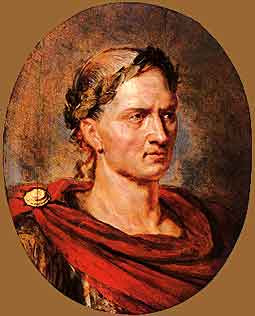
Julius Caesar and Caligula - The Two Roman EmperorsIn ancient Rome, there were rulers who had ultimate power over the empire and its people. While Rome had several rulers, there were some do did not rule for a very long. One good example is that of Julius Caesar. However, his story was very different from that of Caligula's.

Julius Caesar and Caligula - The Two Roman EmperorsDuring Caesar's time, the empire was rocked by several civil wars. Everyone wanted to become the emperor, but it was finally Caesar who ascended to the throne because of his feats on the battlefield. However, his opponents were not comfortable with Caesar's powers as he had total control of the empire and its working. This was the reason why he was assassinated.

During Caesar's reign, he had complete power not just over whole of Rome, but also over the people. The people could not get used to Caesar's dictatorship as they were used to living in a republic. By having a monarch, it meant returning to the days of tyranny wreaked by the monarchy. When Caesar died, it brought a golden age to Rome as Augustus ascended to the throne.

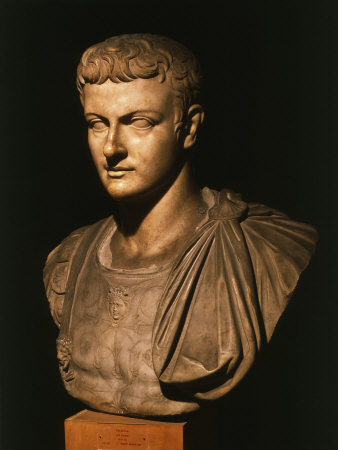
Caligula faced similar issues that Caesar faced. He ruled for 4 years, but his reign was marked with tyranny and he was not at all popular amongst his people. Caligular was born Caius Julius Caesar Germanicus to Germanicus and Agrippina. His father, Germanicus, was high ranking soldier in the Roman army and he died when Caligula was just 4 years old.

Gaius Julius Caesar

Gaius Julius CaesarGaius Julius Caesar was born in a noble family, Julio, around 102 BC. Cognomen, or surname Caesar, meant "Hairy" which was especially inappropriate for Caesar, who was later highly bald. Nomen, or middle name Julius, was the name of the clan, while praenomen Gaius was his personal name.

As a student, while he traveled to study elocution to the Mediterranean island of Rhodes, Caesar was captured by pirates. Who have demanded a ransom of 20 talents, Caesar said that he is worth 50, and swore that, after they get the money, he will come back and crucify all of them. The Pirates thought that he was joking, but when they got the money, previous threat came true, he slit their throats as a sign of kindness. After he barely avoided being killed by the dictator Sulla, Caesar as all the other young aristocrats climbed the ladder from bottom,working in less important republic services. In 70th BC he was elected for quaestor position and sent to the province of Spain.
Gaius Julius CaesarWhen he was in Gades, he saw a statue of Alexander the Great and sighed at the thought that Alexander at the age of 30 years has conquered the whole world, while he himself did not achieve anything important. After he returned to Rome,Caesar worked tirelessly to gain reputation. Till 59 BC he became so influential that he was elected for consul, which was the highest function in the Roman Republic. Together with powerful Pompeii and Crassus they founded the Triumvirate, the rule of three that had the highest power. Caesar was appointed proconsul, or governor of the province of Gaul, and was given command of a huge army. From 58. till 49 BC he won a large area on the other side of Alps. Meanwhile Crassus was killed on Middle East 53 BC in a disastrous military campaign and the Senate got more afraid of Caesar's ambitions. Pompeii sided with the Senate, which on 49 BC ordered Caesar to hand over command over military forces and to return to Rome. Ignoring the command, he led his army across the Rubicon River in Italy and caused a civil war. After Pompeii was killed next year in Egypt, Caesar had no serious enemies. After victory, Rome took a dictatorial direction.

Gaius Julius Caesar

What Network Marketers Can Learn From Julius Caesar's War in Gaul

What Network Marketers Can Learn From Julius Caesar's War in GaulEvery seasoned network marketer knows the importance of maintaining momentum. It is not enough to simply achieve the next position within your company; you must do so with momentum. The combination of positive and passionate emotion, belief in the company, belief in your leader, a non-negotiable attitude and all out action create a psychological synergy that leads to productive momentum. The network marketers who experience high productivity within their teams as a result of this heightened psychological state can only describe it with the phrase, "We seem to be in the zone this month."

What Network Marketers Can Learn From Julius Caesar's War in GaulWhen momentum truly takes hold of your team, everything seems to become effortless. Closing distributers into your business becomes a daily routine. Acquiring new customers for your products or services seems as easy as taking candy from a baby. Getting people to follow you to your company's national training event no longer seems like pulling teeth. All of this takes place not because the company has changed; not because the products have changed; and not because the price to join your business has changed. The only thing that has changed is the mental state of you and your team members. Momentum is the result of the mental synergy created by the factors I mentioned earlier.

But what happens when your team loses momentum? How do you recreate that mental synergy within your team in order to give them that winning edge again? Let's take a peak back in history in order to find the answer.

From 58 B.C. to 51 B.C., Rome fought a series of wars with Gaul (modern day France) known as the Gallic Wars. The Roman forces were commanded by Julius Caesar, and the confederation of Gallic tribes was commanded by the legendary chieftain Vercingetorix. The Gallic wars were long, bloody and taxing for both sides. However, the issue would finally be decided once and for all at the Battle of Alesia.

Shakespeare's Julius Caesar - The Treachery and Deception of Friendly Allegiances

Shakespeare's Julius Caesar - The Treachery and Deception of Friendly AllegiancesJulius Caesar is one of Shakespeare's most famous plays.

It also contains one of the most famous death scenes of all time. There are many themes worth exploring, including free will versus human fate and the inner turmoil that one faces when battling between private self and public self. Julius Caesar demonstrates that no matter what injustices or tragedies we may endure, there is always victory in the end.

Shakespeare's Julius Caesar - The Treachery and Deception of Friendly AllegiancesFlavius and Marallus, two Roman 'judges' meant to protect the rights of Romans. They are in the streets of Rome and see a group of men, walking towards the city's center. They are going to see Julius Caesar, who has recently come back from Pompey rejoicing at his victory. Flavius orders the men to return home, and then asks Marallus to remove all of the ceremonial decorations in the city that are placed for Caesar. Marallus is hesitant to do so until Flavius reminds him they must remove them so that Caesar isn't worshipped and treated like a god. A Soothsayer calls out to Caesar to "beware the Ides of March" but he is ignored.

Brutus and Cassius, who are longtime acquaintances of Caesar converse. Brutus fears the people of Rome want Caesar to become King but he believes it would overturn the Republic. Cassius agrees, also believing that Caesar is just a man, but treated like a god. He blames Brutus and himself for Caesar's rise in power, and draws a plot to bring Brutus into a conspiracy against Caesar. Cassius knows if Brutus believes the people of Rome refuse Caesar as King, then together, they will do whatever they need to do to stop him. Cassius forges letters and places them in Brutus' home. Cassius appears at Brutus' home along with the conspirators, and they all, including Brutus, agree to lure Caesar out of his house and kill him.